
The same blemish, two completely different outcomes
Two people get the same breakout. Same size, same depth, same time to heal. On one, the mark fades within a couple of weeks. On the other, it settles in as a dark patch that’s still visible six months later.
The skincare industry has a long history of calling that second outcome “stubborn” or “resistant,” as if the skin is doing something wrong. It isn’t. It’s doing something different, and that difference has a name: post-inflammatory hyperpigmentation, and it happens more often, more intensely, and for longer in melanin-rich skin because of how melanocytes themselves respond to injury.
What’s actually happening at the cellular level
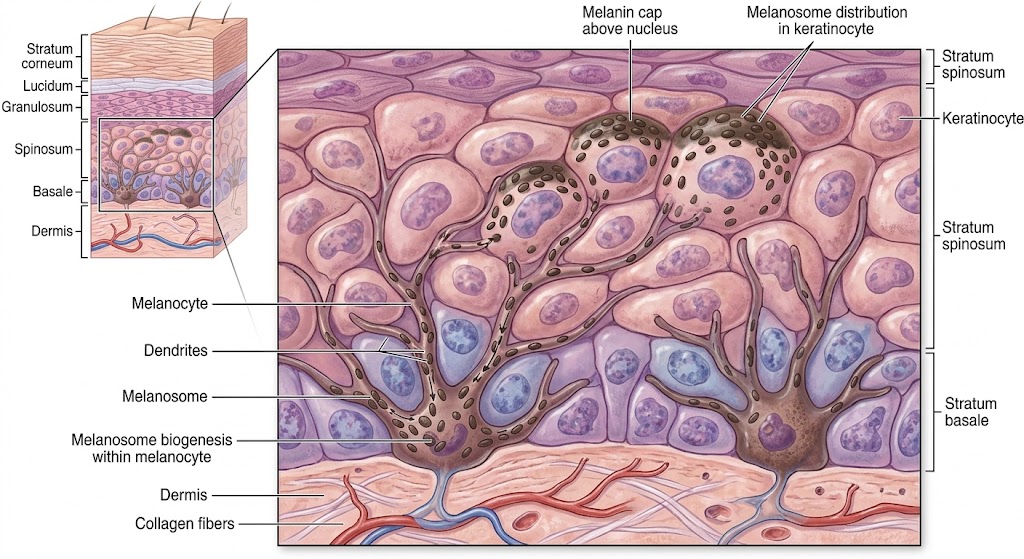
Melanocytes, the pigment-producing cells sitting at the base of the epidermis, don’t just make melanin on a schedule. They respond to signals from the skin around them, especially from keratinocytes, the cells that make up most of the epidermis and that release inflammatory messengers the moment skin is injured or irritated.
When skin is inflamed, whether from acne, a cut, a burn, or even aggressive exfoliation, keratinocytes release cytokines and other signalling molecules that reach nearby melanocytes and tell them to ramp up melanin production as part of the general healing and protective response. This is a normal, healthy mechanism. Melanin has a protective function, and increasing it at a wound site is the skin doing what it’s supposed to do.
The difference in melanin-rich skin isn’t that this process happens where it doesn’t happen elsewhere. It’s that melanocytes in melanin-rich skin tend to be more reactive to these inflammatory signals, and the resulting pigment response tends to be stronger and to persist for longer after the original injury has fully healed.
Not a flaw, a difference that got under-researched
It’s worth being precise about what this is and isn’t. A stronger, longer pigment response to inflammation isn’t a malfunction, and it isn’t unique to any one group in a way that makes it abnormal. It’s a variation in how melanocytes behave, and it exists on a spectrum across skin tones generally.
What turned a biological variation into a persistent skincare problem is that most dermatology research, and most product testing, has historically been carried out on lighter skin, where post-inflammatory hyperpigmentation is a smaller and shorter-lived issue. Treatment advice, ingredient claims, and even the language used to describe “how skin heals” were built on that dataset, then extended to melanin-rich skin on the assumption that skin is skin. Melanocyte biology says otherwise.
Why the mechanism matters more than the mark
Understanding the mechanism, not just the symptom, changes what actually helps. Because the root cause is an exaggerated inflammatory-to-pigment response, the most effective approach usually isn’t to attack the existing mark aggressively. It’s to calm the inflammatory trigger and support melanocyte regulation at the same time, which is a different treatment logic to the one most “dark spot corrector” products are built around.
That’s also why some of the most aggressive, fastest-acting treatments for pigmentation can backfire on melanin-rich skin: they create a new round of irritation, which triggers a new round of melanocyte activation, which can leave a fresh mark on top of the one being treated. We go through exactly which ingredients and approaches actually have evidence behind them for melanin-rich skin, and which ones don’t hold up, in our companion piece, The Hyperpigmentation Treatment Gap in Dark Skin Skincare.
Where to go from here
If you’re trying to understand why your own skin scars the way it does, a free assessment at myskin.ai is a good starting point.
If you’re a brand formulating for melanin-rich skin and want to know whether your evidence actually holds up for that skin type specifically, rather than being borrowed from a lighter-skin dataset, a free 30 minute R&D Diagnostic will tell you whether you need a Discovery Sprint to find the right active, a Validation Programme to prove it works, or both.
Book a free R&D Diagnostic: hexislab.com/rd-diagnostic
Have you noticed your own skin scarring differently than people around you, or has your brand struggled to substantiate a claim for melanin-rich skin specifically? Tell us in the comments or DM us.
Want this applied to your own product?
Pingback: For Brands: Discovery and Validation Programmes for Melanin-Rich Skin – HexisLab Knowledge Hub