
The trade press has stopped calling it a buzzword
For a few years, “AI-powered” on a skincare label meant, more often than not, a quiz and a recommendation engine bolted onto an existing product line. That’s changing, and 2026’s trade coverage is saying so plainly rather than hedging it.
Stylist’s 2026 skincare trends coverage quotes dermatologist Dr Alexis Granite predicting that AI “will shift from a marketing buzzword to a meaningful tool for precision skin diagnostics and hyper-personalised formulation,” with AI-curated routines and adaptive formulas moving from novelty to standard offering. EveLab Insight’s beauty tech reporting points the same direction from the industry side, citing McKinsey’s estimate that generative AI could add $9 to 10 billion in value to the beauty sector, specifically through applications like ingredient formulation support, not just marketing personalisation.
The distinction those two threads are converging on is the one that matters most: AI as a diagnostic and marketing layer sitting on top of conventional formulation is old news. AI actually doing the formulation work, screening and modelling which molecules will perform before a single sample is made, is what’s now being described as standard practice rather than hype.
Two things get called “AI formulation,” and only one of them is
Worth separating clearly, because the term is doing double duty in the market right now.
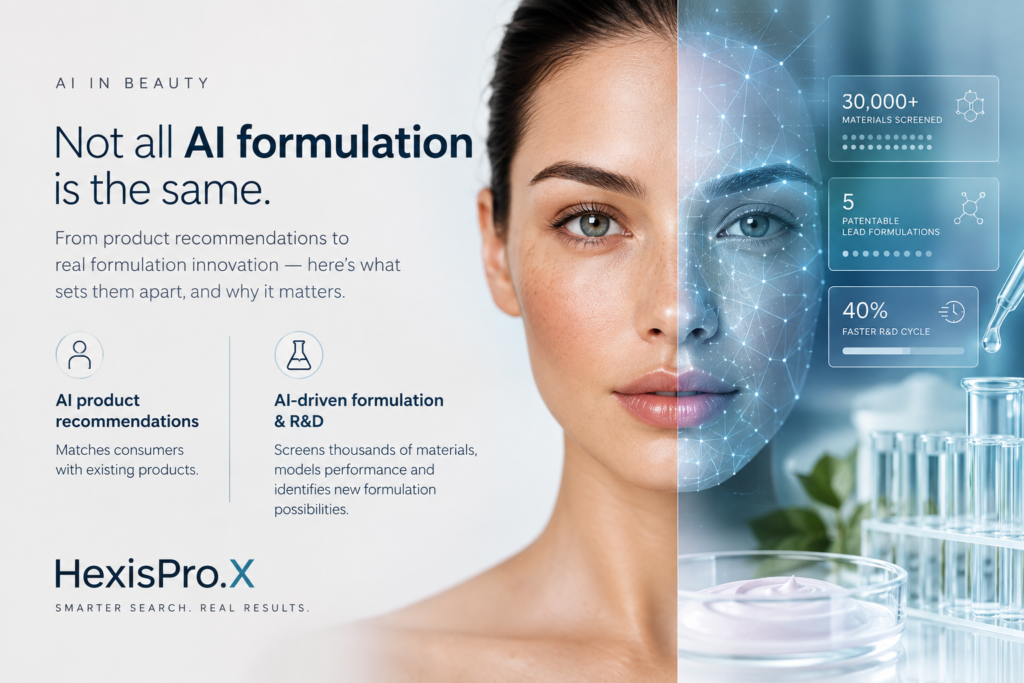
The first is AI as a personalisation and diagnostics layer: a skin-scan app that recommends an existing SKU, or a quiz that blends a routine from products already on the shelf. This is genuinely useful, and it’s the version most consumers will meet first, but it isn’t formulation. It’s routing people to formulations that already exist.
The second is AI actually doing formulation work: screening thousands of candidate molecules against a target biological mechanism, modelling how they’ll behave before synthesis, and ranking candidates by predicted performance, tolerability, and manufacturability. This is slower, less visible to a consumer, and it’s the version that changes what a brand can actually develop, not just how a product gets marketed to a shopper.
The trade press quotes above are describing both trends colliding into the same moment, but for a brand deciding where to invest, the second one is where the durable advantage sits. Recommendation engines are relatively easy to build or license. AI that shortens a genuine discovery timeline is not.
What this looks like when it isn’t a pitch deck
This is the version of AI-driven formulation HexisPro.X, our AI discovery and screening platform, is built to run. For a global skincare client, we screened over 30,000 candidate materials down to 5 lead formulations strong enough to file patents on, using in silico modelling to predict activity and tolerability before a single candidate reached the lab bench. For a leading haircare brand, the same approach behind the platform delivered a 40% reduction in R&D cycle time.
The point isn’t the size of the number, it’s what the number represents: a search space too large to work through by conventional screening, narrowed down computationally to the candidates actually worth testing. That’s the difference between AI as a demo and AI as a working part of the R&D pipeline, and it’s the same platform behind Hexis Lab’s own in-market formulations, Layla & Kays and Couronne.
What this means if you’re evaluating a formulation partner
As “AI-driven formulation” becomes a standard claim rather than a differentiator, the useful question for a brand stops being “do you use AI” and becomes “what does your AI actually screen for, and can you show the output.” Ask what search space it’s working across, what it’s predicting, and whether the candidates it surfaces have ever been validated against real assay data, not just modelled.
At Hexis Lab, that AI-driven screening is the front end of a longer, evidence-based pipeline: a Discovery Sprint uses HexisPro.X to identify and rank candidate actives, a Validation Programme proves the strongest candidates actually work with lab evidence, and a Formulation Programme turns a validated active into a manufacturable product. The AI narrows the search. The lab work is still what proves the result.
Where to go from here
If you’re a brand deciding whether AI-driven formulation is worth building into your own R&D pathway, or evaluating a partner who claims to already offer it, a free 30 minute R&D Diagnostic will tell you what’s actually possible for your product or ingredient idea, and which programme, Discovery, Validation, Formulation, or End-to-End, would get you there.
Book a free R&D Diagnostic: hexislab.com/rd-diagnostic
What’s your experience been with “AI-powered” claims in the products you use or the partners you’ve evaluated, more substance or more marketing? Tell us in the comments or DM us.
Want this applied to your own product?